Saturday, January 9, 2010

Spirit Faces Uncertain Future as New Year Dawns


Spirit landed on Mars at 8:35 p.m. PST on Jan. 3, 2004, and its twin Opportunity arrived at 9:05 p.m. Jan. 24, 2004. The rovers began missions intended to last for just three months but which have instead gone on for six Earth years, or 3.2 Mars years. During this time, Spirit has found evidence of a steamy and violent environment on ancient Mars that was quite different from the wet and acidic past documented by Opportunity, which has been operating successfully halfway around the planet.

A sand trap and balky wheels are challenges to Spirit's mobility that could prevent NASA's rover team from using a key winter-survival strategy. The team might not be able to position the robot's solar panels to tilt toward the sun to collect power for heat to survive the severe Martian winter.

Nine months ago, Spirit was driving across a place called "Troy" when its wheels broke through a crusty surface layer into loose sand. Efforts to escape this sand trap barely have budged the rover. The rover's inability to use all six wheels for driving has worsened the predicament. Spirit's right-front wheel quit working in 2006, and its right-rear wheel stalled a month ago. Surprisingly, the right-front wheel recently resumed working, though intermittently. Drives with four or five operating wheels have produced little progress and the latest attempts have resulted in the rover actually sinking deeper in the soil.

"The highest priority for this mission right now is to stay mobile, if that's possible," says Steve Squyres of Cornell University in Ithaca, N.Y. He is principal investigator for the rovers.

If mobility is not possible, the next priority is to improve the rover's tilt, while Spirit is able to generate enough electricity to turn its wheels. Spirit is in the southern hemisphere of Mars, where it is autumn, and the amount of daily sunshine available for the solar-powered rover is declining. This could result in ceasing extraction activities as early as January, depending on the amount of remaining power. Spirit's tilt, nearly five degrees toward the south, is unfavorable because the winter sun crosses low in the northern sky.

Unless the tilt can be improved or winds lessen the gradual buildup of dust on the solar panels, the amount of sunshine available will continue to decline until May 2010. During May, or perhaps earlier, Spirit may not have enough power to remain in operation.

"At the current rate of dust accumulation, solar arrays at zero tilt would provide barely enough energy to run the survival heaters through the Mars winter solstice," says Jennifer Herman, a rover power engineer at NASA's Jet Propulsion Laboratory in Pasadena, Calif.

The team is evaluating strategies for improving the tilt even if Spirit cannot escape the sand trap, such as trying to dig in deeper with the wheels on the north side. In February, NASA will assess Mars missions, including Spirit, for their potential science versus costs to determine how to distribute limited resources. Meanwhile, the team is planning additional research about what a stationary Spirit could accomplish as power wanes.

"Spirit could continue significant research right where it is," says Ray Arvidson of Washington University in St. Louis, deputy principal investigator for the rovers. "We can study the interior of Mars, monitor the weather and continue examining the interesting deposits uncovered by Spirit's wheels."

A study of the planet's interior would use radio transmissions to measure wobble of the planet's axis of rotation, which is not feasible with a mobile rover. That experiment and others might provide more and different findings from a mission that has already far exceeded expectations.

"Long-term change in the spin direction could tell us about the diameter and density of the planet's core," says William Folkner of JPL. He has been developing plans for conducting this experiment with a future, stationary Mars lander. "Short-period changes could tell us whether the core is liquid or solid."

Spirit may be stuck and in peril, but the rover still has a lot of work to do. Stay tuned for updates from Science@NASA.

source....

Friday, January 8, 2010

Wood Thief Returns!

I have to take back what I said! I can't believe this, but my wood thief came back while I was milking the cows tonight. He came down to the barn, paid me, and bought more. He said he was on his way home in the middle of the night last night when his wife called him and told him they were out of wood. He said he didn't have any money with him, so loaded the trunk of his car with enough for the night. I only wish he had left a note in my "Put Money In Here" can, but I guess it all turned out ok in the end. Maybe there really is one honest person yet!

So, I guess I really have never had any firewood stolen from me so far!

- Quads, hailing from Grand Marsh Observatory atop Elk Castle Hill

Stolen Firewood - First Time For Me!


In the middle of last night, somebody pulled off the road into my driveway and filled the trunk of their car with about $10 worth of my firewood from my display. I am actually surprised, and at the same time a little bit relieved, because I expected this to happen a long time ago.

I'm not mad about it, I give away 100 times that amount every year. Quite the opposite of mad actually. I'm excited! This could be fun. If it happens again, then the game is on. For five minutes worth of cutting, splitting, and hauling a few pieces of firewood, I am anticipating a great game of cat and mouse. My display of firewood out by the road will be the bait for the rattrap! BRING IT ON LOWLIFE! I'm ready to play.

- Quads, hailing from Grand Marsh Observatory atop Elk Castle Hill

ISS Tonight

8 Jan -3.0 18:15:32 WSW 56

- Quads, hailing from Grand Marsh Observatory atop Elk Castle Hill

Glowing walls could kill off the light bulb

Light-emitting wallpaper may begin to replace light bulbs from 2012, according to a government body that supports low-carbon technology.

A chemical coating on the walls will illuminate all parts of the room with an even glow, which mimics sunlight and avoids the shadows and glare of conventional bulbs.

Although an electrical current will be used to stimulate the chemicals to produce light, the voltage will be very low and the walls will be safe to touch. Dimmer switches will control brightness, as with traditional lighting.

The Carbon Trust has awarded a £454,000 grant to Lomox, a Welsh company that is developing the organic light-emitting diode technology. The trust said it would be two and a half times more efficient than energysaving bulbs and could make a big contribution to meeting Britain’s target of cutting carbon emissions by 34 per cent by 2020. Indoor lighting accounts for a sixth of total electricity use.

The chemical coating, which can be applied in the form of specially treated wallpaper or simply painted straight on to walls, can also be used for flat-screen televisions, computers and mobile phone displays.

As the system uses only between three and five volts, it can be powered by solar panels or batteries. Lomox, which will use the grant to prove the durability of the technology, believes it could be used in the first instance to illuminate road signs or barriers where there is no mains electricity.

Ken Lacey, the chief executive of Lomox, said that the first products would go on sale in 2012. “The light is a very natural, sunlight-type of lighting with the full colour range. It gives you all kinds of potential for how you do lighting,” he said.

Although organic light-emitting diodes (LEDs) have been available for several years, Mr Lacey said that concerns over cost and durability had prevented further development. He said that Lomox had developed a much cheaper process and discovered a combination of chemicals that were not vulnerable to the oxidation that shortened the operating life span of other types of organic LEDs.

Mr Lacey said the technology could be used to make flexible screens that could be rolled up after use, or carried into a presentation, for example.

Mark Williamson, director of innovations at the Carbon Trust, said: “Lighting is a major producer of carbon emissions. This technology has the potential to produce ultra-efficient lighting for a wide range of applications, tapping into a huge global market.

“It’s a great example of the innovation that makes the UK a hotbed of clean technology development.”

source....

Thursday, January 7, 2010

Black River State Forest Conditions as of Wednesday, January 6, 2010:

Snowmobile and All-terrain Vehicle (ATV) Trails

All snowmobile and ATV trails in the state forest are open and in fair shape. They were last groomed on Monday January 4. The base is not very deep but what is there is very firm with some areas potentially icy. Trails will be groomed again on Friday if we get the predicted snowfall.

Club trails to the west of the Black River State Forest are in especially poor shape and may close down.

source....

brightest star-like point of light

The planet Jupiter highlights the southwestern evening sky this month. It is the brightest star-like point of light in the early evening, so you can't miss it.

- Quads, hailing from Grand Marsh Observatory atop Elk Castle Hill

Hundreds of dead animals found in Philly home

Investigators say some kind of religious ritual may be behind the discovery of the remains of 400 to 500 dead animals at a Philadelphia house.

Officer George Bengal, director of law enforcement at the Pennsylvania SPCA, says investigators spent hours combing through the home in the city's Feltonville neighborhood Wednesday.

He says the animals were apparently used in some kind of religious ritual. The remains include deer, turtles and other animals.

Authorities are trying to find the people who lived in the rented home.

Bengal says that there is no law against sacrificing animals for religious purposes as long as it is done humanely.

Pennsylvania Game Commission officials say that if the residents had a permit or license to capture the wildlife, it could be OK.

A report of dogs living in unsanitary conditions initially led animal control officers to the house.

source....

ISS Tonight

7 Jan -3.0 17:53:54 SW 51

- Quads, hailing from Grand Marsh Observatory atop Elk Castle Hill

Wednesday, January 6, 2010

Leaner

I rarely ever cut standing dead trees. There are so many already on the ground, and between those and the ones that will soon fall on their own, it keeps me busy enough without cutting the standing ones. This nice little dead white oak was easy pickings right next to the trail, with the snow-cover and all. Besides, it was going to someday fall across the trail anyway. So I cut it.


And wouldn't you know it, the one standing tree I cut down in a long time and the first thing it does is get hung up! Oh well. One cut at a time, kick it, one more cut, another kick...


...and eventually it's all on the ground and cut up.


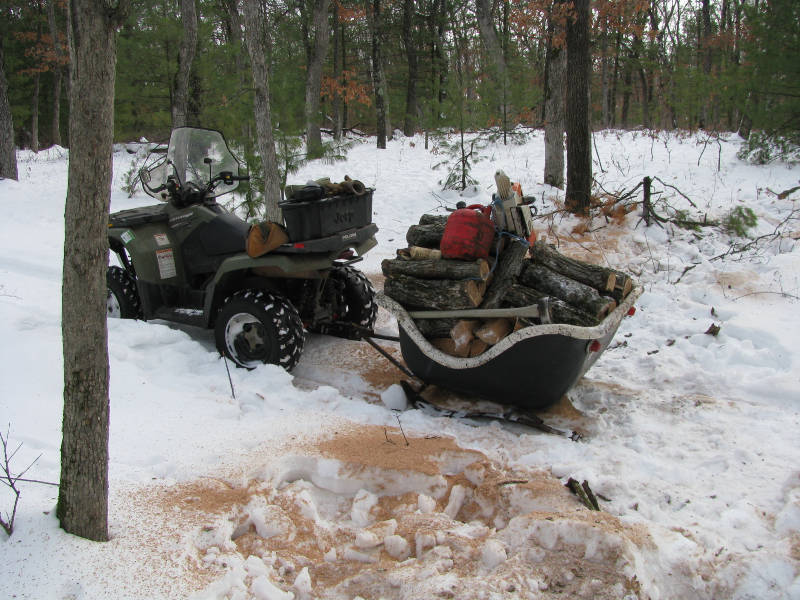
I'm going to end up destroying my little old sled. Somehow I don't think it was designed for this, but I got every last piece of firewood from that tree on in one load! One word of advice; don't buy a round gas can. They're just not smart enough to stay put. I'm hoping someday I run over this one and wreck it, then I can justify buying a new one; a SQUARE one! I tied it to my 026, and even then the stupid round gas can tried to push my antique Wolf's Head bar oil bottle over the edge (is Wolf's Head still in business?). My 026 never falls off. My magnificent maul never falls off either. Is there anything that maul can't do?


Passing a few of my "woods stacks" on the way back home.


I made it almost the mile back home, about right here, before pieces of firewood starting tumbling off the sled!


- Quads, hailing from Grand Marsh Observatory atop Elk Castle Hill