Licenses for current year expire on March 31
Wisconsin hunting, fishing, trapping and other licenses and harvest permits for fish and wildlife activities in Wisconsin go on sale Wednesday, March 10. Annual licenses are valid from April 1, 2010 through March 31, 2011. Hunting and fishing licenses for the 2009-10 license year expire on March 31, 2010.
“We’re here to answer questions regarding licenses as folks plan their hunting and fishing trips, purchase a recreational vehicle, or pursue other activities. Just contact our call center,” said Kevin Huggins, chief of licensing and information for the Department of Natural Resources.
DNR customer service staff is available to assist the public by phone and online from 7 a.m. to 10 p.m., seven days a week. Spanish and Hmong bilingual customer service representatives are also available.
Customers may reach Customer Service at 1-888-WDNRINFo (1-888-936-7463) or by e-mail at csweb@wisconsin.gov. An online chat link is also available at dnr.wi.gov/contact.
Information on renewing a Conservation Patrons License, which offers many different privileges, including licenses, stamps, applications, park admission and more, was included in the February issue of Wisconsin Natural Resources magazine, along with a bonus pamphlet showing how fish and wildlife license and permit fees are spent to bolster outdoor recreation.
Hunting and fishing licenses can be purchased over the Internet through the DNR Web page (click on Hunting & Fishing Licenses and Permits under Online Services); by calling toll-free 1-877-WI LICENSE (1-877-945-4236); at license sales locations; or DNR service centers during their regular business hours (check service center link for hours of operation, which vary by service center).
FOR MORE INFORMATION CONTACT: Bureau of Customer Service and Licensing, (608) 266-2621
source....
Sunday, February 28, 2010
Saturday, February 27, 2010
Callaway Motorsports,Wiseco 2003 KX327cc Modified by Tom Morgan and Race Tech
Many years ago the outdoor national championships were split into three separate classes, the 125cc, 250cc and 500cc or open class as some liked to call it. The 125 class was contested by the young up and comers of the sport, while the 250 and Open division championships were contested by the more experienced racers of the day. While the 125 kids would battle it out for the full length of the series on the smaller mills, the big bikes series was split into two separate championships. The 250 National title would be decided during the first half of the outdoor series and then riders would switch over to the more powerful 500cc machines to battle it out for the Open class Championship. As the years progressed, many factories began to loose interest in the open class, as sales of these high-powered machines were down and several of the companies no longer produced an open class motocross bike. Honda and Kawasaki became the only title contenders in the open class, as they were the only two manufactures that were still selling an open class motocross bike and these bikes were even dated, as the companies were no longer putting any effort into the development of these bikes. Factory riders and privateers that raced other brands that no longer built open class bikes had to drop down to the 125 class or ride highly modified 250cc machines against the powerful 500cc Hondas and Kawasaki's. As it became more apparent that the open class was doomed to become extinct, the AMA made the decision to drop the class from AMA competition and created the 125/250cc National Championships of today.
Now that the Open class is dead in AMA national competition, the question is sometimes asked, what two stroke can a guy race and be competitive with in open class race events. Yes, these events are rare, but there is one open race in the country that still thrives and that is held once a year at the Mammoth Mountain Motocross, in Mammoth Lakes California every June.
Mammoth has been a staple event on most serious racers calendar for many years and it is often appealing for riders to enter all three-displacement classes at Mammoth, to vie for the overall championship. Back in the day, Mammoth Mountain offered a large chunk of change and the prestige of being king of Mammoth to the rider that scored the best combined finishes in the 125, 250 and 500cc classes. Sure it would be easy to hop on one of the big four stroke machines that are now commonplace in today's 250cc class, but what if you are a two-stroke kind of guy, or are sponsored by a manufacture that doesn't yet offer a big displacement 4-stroke? Well, you do what many racers of the past did; you build yourself a big bore 250cc 2-stroke.
With Mammoth just around the corner, we got a phone call from our friend Jay Clark from Wiseco Piston fame. Jay just happened to be building a big bore Kawasaki 250 for just the occasion of the Mammoth race. As always, Jay wanted our feed back on his special project bike and even offered to let us enter it at Mammoth this year. How could we refuse a chance to race someone else's bike at a race such as this?
Jay started off with a box stock 2003 Kawasaki KX 250 provided by Callaway Motorsports. He first stripped the bike down to its bare frame and sent out the motor to former Kawasaki factory mechanic Tom Morgan. Tom Morgan Racing who relocated from Lake Havasu City Arizona, now in San Bernardino California, tore into the motor to create a fire breathing 327cc monster. He began by boring the cases to accept the longer (3.5mm) stroke and then blue printed the entire motor. The Hot Rod crank is stroked by moving the crank pin and welding new weights to offset the difference and is rebalanced for the new rod and huge 74mm Wiseco piston. Do to the much larger then stock piston, the cylinder is welded and stress relieved because of the large bore size. Tom completes the top-end assembly with a Cometic base spacer and a larger bore head gasket.. Now, with a whopping 54+ horsepower, Morgan opted for a larger 14-tooth counter shaft sprocket to make the KX a bit more rider friendly.
While the motor was being built at Tom Morgan Racing, Jay had the suspension over at Race Tech, where Paul Thede and the boys worked their magic. A complete revalve front and rear was done, utilizing the Race Tech Gold Valves. Spring rates were changed to a .42 up front and a 4.8 out back. Race Tech set this up based on our racers weight and skill level and based on Race Techs many years of racing experience at the Mammoth Mountain race.
While the motor was out getting some more power breathed into it and the suspension was off being massaged, Jay was hard at work assembling the chassis with its fresh B&B powder coated frame. Jay doesn't like to just build up a stock bike with a few mods. Jay likes to go all the way and turn his bikes into one off aftermarket works of art. Mr. Clark built one heck of a nice ride, using parts from many top quality manufactures in his final assembly. Although the color choice on the frame was a little bit Bling Bling for our taste, the bike had an attractive factory look to it.
Once the bike was ready for it's maiden voyage, Jay, Tom Morgan and the Race Tech boys met us out at Glen Helen Raceway for break in and some fine tuning to get ready for the Mammoth event. Initially the bike was a bit hard to start when cold due to the increased compression, but once it was warm we had little problem with starting. As we headed out on the first lap, we quickly realized that this wasn't your ordinary hopped up KX 250. With a bit more vibration then a stock 250, the 327 pulled a lot stronger throughout the power band. We could only imagine how valiant it would have been had the original 13 tooth sprocket not been swapped out for the more forgiving 14 tooth. The KX 327 was actually very rider friendly and required us to ride it the same way that we would ride our regular 250. One thing that we hoped that would have been improved over stock was the lack of top-end over rev, but the 327 still pulled short at the very top of the power band. We would most likely not have noticed this as much, but Glen Helen is famous for having ridiculously long straights that require a bike to pull long on top or to be shifted a bit more than on most tracks.
Our Race Tech suspension performed well, but would require some more time to get it dialed in for out faster more aggressive tester. As the day went on the track became much rougher and our tester became more aggressive as he got more comfortable with the bike and the track, thus requiring a different setting. This is nothing that Race Tech couldn't handle and this test gave us a good baseline for the Mammoth track. Our test crew felt that the track conditions at Mammoth would be better for the suspension settings that Race Tech provided.
Our test riders unanimously agreed that the KX 327 would be an excellent cheater bike in the 250 class, as the new 450cc 4-strokes are becoming more and more difficult to hang with on a 250cc 2-stroke. Even vet riders could take advantage of the extra HP, as many vet classes aren't restricted to motor displacement. Although we don't cheat ourselves and don't recommend cheating to anyone, it will be interesting to see what happens in the very near future, as it is fast becoming much more difficult to hang with the 450 4-strokes. With the power that the KX 327 produces and the ride ability of the complete package, this bike is a definite 4-stroke killer.
Cylinder & Head Modification/Porting and big bore of cylinder by Millennium technologies. Blue printing engine (Trans mods and matching cases) Crank Lighten, Balance and 3.5mm stroker, TMR Wiseco 74mm big bore KX piston. Cometic gasket custom head and base gaskets with spacer plate. FMF SST Pipe and spacers to a FMF Titanium silencer. A Moto Tassinari V force reed valve system (off a Jet Ski). Redline Water Wetter
This type of custom project with all of it parts from TMR isn't cheap and cost in the $2000 range. This figure is a rough estimate and would depend on how much R&D time of Tom Morgan's your looking for
This custom one-off motor is only available with all of its trick aftermarket parts from TMR. That would include; Wiseco Piston, Millennium Technologies, Cometic, FMF and Moto Tassinari
source....
Now that the Open class is dead in AMA national competition, the question is sometimes asked, what two stroke can a guy race and be competitive with in open class race events. Yes, these events are rare, but there is one open race in the country that still thrives and that is held once a year at the Mammoth Mountain Motocross, in Mammoth Lakes California every June.
Mammoth has been a staple event on most serious racers calendar for many years and it is often appealing for riders to enter all three-displacement classes at Mammoth, to vie for the overall championship. Back in the day, Mammoth Mountain offered a large chunk of change and the prestige of being king of Mammoth to the rider that scored the best combined finishes in the 125, 250 and 500cc classes. Sure it would be easy to hop on one of the big four stroke machines that are now commonplace in today's 250cc class, but what if you are a two-stroke kind of guy, or are sponsored by a manufacture that doesn't yet offer a big displacement 4-stroke? Well, you do what many racers of the past did; you build yourself a big bore 250cc 2-stroke.
With Mammoth just around the corner, we got a phone call from our friend Jay Clark from Wiseco Piston fame. Jay just happened to be building a big bore Kawasaki 250 for just the occasion of the Mammoth race. As always, Jay wanted our feed back on his special project bike and even offered to let us enter it at Mammoth this year. How could we refuse a chance to race someone else's bike at a race such as this?
Jay started off with a box stock 2003 Kawasaki KX 250 provided by Callaway Motorsports. He first stripped the bike down to its bare frame and sent out the motor to former Kawasaki factory mechanic Tom Morgan. Tom Morgan Racing who relocated from Lake Havasu City Arizona, now in San Bernardino California, tore into the motor to create a fire breathing 327cc monster. He began by boring the cases to accept the longer (3.5mm) stroke and then blue printed the entire motor. The Hot Rod crank is stroked by moving the crank pin and welding new weights to offset the difference and is rebalanced for the new rod and huge 74mm Wiseco piston. Do to the much larger then stock piston, the cylinder is welded and stress relieved because of the large bore size. Tom completes the top-end assembly with a Cometic base spacer and a larger bore head gasket.. Now, with a whopping 54+ horsepower, Morgan opted for a larger 14-tooth counter shaft sprocket to make the KX a bit more rider friendly.
While the motor was being built at Tom Morgan Racing, Jay had the suspension over at Race Tech, where Paul Thede and the boys worked their magic. A complete revalve front and rear was done, utilizing the Race Tech Gold Valves. Spring rates were changed to a .42 up front and a 4.8 out back. Race Tech set this up based on our racers weight and skill level and based on Race Techs many years of racing experience at the Mammoth Mountain race.
While the motor was out getting some more power breathed into it and the suspension was off being massaged, Jay was hard at work assembling the chassis with its fresh B&B powder coated frame. Jay doesn't like to just build up a stock bike with a few mods. Jay likes to go all the way and turn his bikes into one off aftermarket works of art. Mr. Clark built one heck of a nice ride, using parts from many top quality manufactures in his final assembly. Although the color choice on the frame was a little bit Bling Bling for our taste, the bike had an attractive factory look to it.
Once the bike was ready for it's maiden voyage, Jay, Tom Morgan and the Race Tech boys met us out at Glen Helen Raceway for break in and some fine tuning to get ready for the Mammoth event. Initially the bike was a bit hard to start when cold due to the increased compression, but once it was warm we had little problem with starting. As we headed out on the first lap, we quickly realized that this wasn't your ordinary hopped up KX 250. With a bit more vibration then a stock 250, the 327 pulled a lot stronger throughout the power band. We could only imagine how valiant it would have been had the original 13 tooth sprocket not been swapped out for the more forgiving 14 tooth. The KX 327 was actually very rider friendly and required us to ride it the same way that we would ride our regular 250. One thing that we hoped that would have been improved over stock was the lack of top-end over rev, but the 327 still pulled short at the very top of the power band. We would most likely not have noticed this as much, but Glen Helen is famous for having ridiculously long straights that require a bike to pull long on top or to be shifted a bit more than on most tracks.
Our Race Tech suspension performed well, but would require some more time to get it dialed in for out faster more aggressive tester. As the day went on the track became much rougher and our tester became more aggressive as he got more comfortable with the bike and the track, thus requiring a different setting. This is nothing that Race Tech couldn't handle and this test gave us a good baseline for the Mammoth track. Our test crew felt that the track conditions at Mammoth would be better for the suspension settings that Race Tech provided.
Our test riders unanimously agreed that the KX 327 would be an excellent cheater bike in the 250 class, as the new 450cc 4-strokes are becoming more and more difficult to hang with on a 250cc 2-stroke. Even vet riders could take advantage of the extra HP, as many vet classes aren't restricted to motor displacement. Although we don't cheat ourselves and don't recommend cheating to anyone, it will be interesting to see what happens in the very near future, as it is fast becoming much more difficult to hang with the 450 4-strokes. With the power that the KX 327 produces and the ride ability of the complete package, this bike is a definite 4-stroke killer.
Cylinder & Head Modification/Porting and big bore of cylinder by Millennium technologies. Blue printing engine (Trans mods and matching cases) Crank Lighten, Balance and 3.5mm stroker, TMR Wiseco 74mm big bore KX piston. Cometic gasket custom head and base gaskets with spacer plate. FMF SST Pipe and spacers to a FMF Titanium silencer. A Moto Tassinari V force reed valve system (off a Jet Ski). Redline Water Wetter
This type of custom project with all of it parts from TMR isn't cheap and cost in the $2000 range. This figure is a rough estimate and would depend on how much R&D time of Tom Morgan's your looking for
This custom one-off motor is only available with all of its trick aftermarket parts from TMR. That would include; Wiseco Piston, Millennium Technologies, Cometic, FMF and Moto Tassinari
source....

Friday, February 26, 2010
How I Make Firewood With Minimal Equipment And No Heavy Lifting


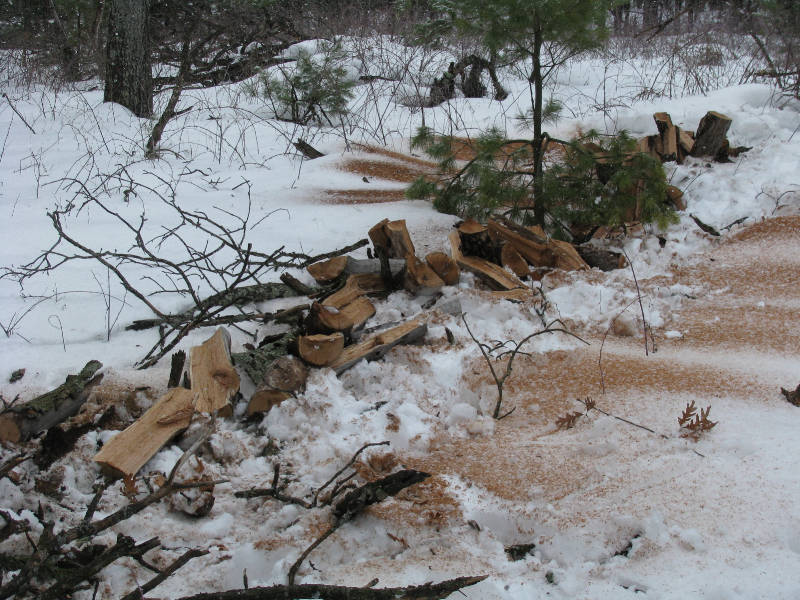


Done. After several seasons of drying, this will be some very nice firewood (or by next week if I point a dehumidifier at it, according to a rumor I heard).
- Quads, hailing from Grand Marsh Observatory atop Elk Castle Hill
Thursday, February 25, 2010
History in the Remaking

They call it potbelly hill, after the soft, round contour of this final lookout in southeastern Turkey. To the north are forested mountains. East of the hill lies the biblical plain of Harran, and to the south is the Syrian border, visible 20 miles away, pointing toward the ancient lands of Mesopotamia and the Fertile Crescent, the region that gave rise to human civilization. And under our feet, according to archeologist Klaus Schmidt, are the stones that mark the spot—the exact spot—where humans began that ascent.
Standing on the hill at dawn, overseeing a team of 40 Kurdish diggers, the German-born archeologist waves a hand over his discovery here, a revolution in the story of human origins. Schmidt has uncovered a vast and beautiful temple complex, a structure so ancient that it may be the very first thing human beings ever built. The site isn't just old, it redefines old: the temple was built 11,500 years ago—a staggering 7,000 years before the Great Pyramid, and more than 6,000 years before Stonehenge first took shape. The ruins are so early that they predate villages, pottery, domesticated animals, and even agriculture—the first embers of civilization. In fact, Schmidt thinks the temple itself, built after the end of the last Ice Age by hunter-gatherers, became that ember—the spark that launched mankind toward farming, urban life, and all that followed.
Göbekli Tepe—the name in Turkish for "potbelly hill"—lays art and religion squarely at the start of that journey. After a dozen years of patient work, Schmidt has uncovered what he thinks is definitive proof that a huge ceremonial site flourished here, a "Rome of the Ice Age," as he puts it, where hunter-gatherers met to build a complex religious community. Across the hill, he has found carved and polished circles of stone, with terrazzo flooring and double benches. All the circles feature massive T-shaped pillars that evoke the monoliths of Easter Island.
Though not as large as Stonehenge—the biggest circle is 30 yards across, the tallest pillars 17 feet high—the ruins are astonishing in number. Last year Schmidt found his third and fourth examples of the temples. Ground-penetrating radar indicates that another 15 to 20 such monumental ruins lie under the surface. Schmidt's German-Turkish team has also uncovered some 50 of the huge pillars, including two found in his most recent dig season that are not just the biggest yet, but, according to carbon dating, are the oldest monumental artworks in the world.
The new discoveries are finally beginning to reshape the slow-moving consensus of archeology. Göbekli Tepe is "unbelievably big and amazing, at a ridiculously early date," according to Ian Hodder, director of Stanford's archeology program. Enthusing over the "huge great stones and fantastic, highly refined art" at Göbekli, Hodder—who has spent decades on rival Neolithic sites—says: "Many people think that it changes everything…It overturns the whole apple cart. All our theories were wrong."
Schmidt's thesis is simple and bold: it was the urge to worship that brought mankind together in the very first urban conglomerations. The need to build and maintain this temple, he says, drove the builders to seek stable food sources, like grains and animals that could be domesticated, and then to settle down to guard their new way of life. The temple begat the city.
source....
Wednesday, February 24, 2010
Alpha Monocerotis
Alpha Monocerotis, the brightest star of Monoceros, the unicorn, is nearing the end of its life. Internal changes have caused the star to puff up like a big balloon, growing so bright that it is visible across about 145 light-years of space.
- Quads, hailing from Grand Marsh Observatory atop Elk Castle Hill
- Quads, hailing from Grand Marsh Observatory atop Elk Castle Hill
Tuesday, February 23, 2010
NASA officials ponder the future
Space shuttle Endeavour has returned to Earth, leaving only four more shuttle flights in the program and leading NASA officials to ponder the future.
The shuttle and its crew, led by George Zamka, landed at 10:20 p.m. EST Sunday at the Kennedy Space Center, ending a 14-day, 5.7-million-mile mission to the International Space Station.
"We've come a long way in human spaceflight because of the shuttle's capability," Zamka said. "We've launched and retrieved satellites, we've done medical research and now we've built this huge space station. We're almost to the point of passing the baton from the space shuttle to the space station in terms of what our human spaceflight experience will be now."
Kwatsi Alibaruho, lead STS-130 space shuttle flight director, said even with so much left to do in the shuttle program's final four flights, he was making it a point to spend some time thinking about the subject.
"It's very easy to get into a routine, to lose oneself in the hustle and bustle of trying to get the work done," Alibaruho said. "But the shuttle is a unique spacecraft. I find myself thinking a lot about how I'm going to describe this time to my son when he's old enough to understand. There has never been an operational spacecraft like (the shuttle) before and all indications are that it will be some time before there will be one like it again."
source....
The shuttle and its crew, led by George Zamka, landed at 10:20 p.m. EST Sunday at the Kennedy Space Center, ending a 14-day, 5.7-million-mile mission to the International Space Station.
"We've come a long way in human spaceflight because of the shuttle's capability," Zamka said. "We've launched and retrieved satellites, we've done medical research and now we've built this huge space station. We're almost to the point of passing the baton from the space shuttle to the space station in terms of what our human spaceflight experience will be now."
Kwatsi Alibaruho, lead STS-130 space shuttle flight director, said even with so much left to do in the shuttle program's final four flights, he was making it a point to spend some time thinking about the subject.
"It's very easy to get into a routine, to lose oneself in the hustle and bustle of trying to get the work done," Alibaruho said. "But the shuttle is a unique spacecraft. I find myself thinking a lot about how I'm going to describe this time to my son when he's old enough to understand. There has never been an operational spacecraft like (the shuttle) before and all indications are that it will be some time before there will be one like it again."
source....
Monday, February 22, 2010
ISS Tomorrow Morning
23 Feb -2.6 05:26:55 SW 34
- Quads, hailing from Grand Marsh Observatory atop Elk Castle Hill
- Quads, hailing from Grand Marsh Observatory atop Elk Castle Hill
My Camera-shy Audience


- Quads, hailing from Grand Marsh Observatory atop Elk Castle Hill
Sunday, February 21, 2010
First images from Nasa's Wise infrared sky probe

Nasa has published the first images from its Wide-field Infrared Survey Explorer, or Wise, which has been scanning the skies since January.
"Wise has worked superbly," said the agency's Ed Weiler in Washington DC.
The images include a comet, a "star factory" 20,000 light years away in our Milky Way galaxy and our nearest large neighbour, the Andromeda spiral galaxy.
Wise will search on until October when its supplies of frozen coolant for chilling instruments will run out.
It's hoped it will find many more comets and, from them, provide information about the birth of our Solar System. It's also looking for asteroids and cool stars called brown dwarfs.
By the time the mission ends the explorer should have scanned the sky one-and-a-half-times with its "infrared goggles", revealing objects not visible to the naked eye.
"All these pictures tell a story about our dusty origins and destiny," said Peter Eisenhardt, Wise project director at Nasa in California.
"Wise sees dusty comets and rocky asteroids tracing the formation and evolution of our solar system. We can map thousands of forming and dying solar systems across our entire galaxy.
"We can see patterns of star formation across other galaxies, and waves of star-bursting galaxies in clusters millions of light years away," he explained.
source....
ISS Tomorrow Morning
22 Feb -3.3 05:05:19 E 75
- Quads, hailing from Grand Marsh Observatory atop Elk Castle Hill
- Quads, hailing from Grand Marsh Observatory atop Elk Castle Hill
Subscribe to:
Posts (Atom)