7 Feb -3.2 05:41:03 SW 72
- Quads, hailing from Grand Marsh Observatory atop Elk Castle Hill
Saturday, February 6, 2010
Friday, February 5, 2010
Officials fear another whooping crane die-off
The world's last remaining natural flock of endangered whooping cranes, which suffered a record number of deaths last year, will probably see another die-off because of scarce food supplies at its Texas nesting grounds this winter, wildlife managers said.
The flock lost 23 birds in the 2008-2009 winter season, in part because its main source of sustenance, the blue crab, all but vanished from drought-parched southern Texas. The rains eventually came, but they were too late to produce healthy amounts of blue crabs for this winter.
“We're looking at a pretty slender year, prey-wise, and it's going to make the cranes work harder to get food,” said Allan Strand, field supervisor for the U.S. Fish and Wildlife Service in South Texas. “I feel that we're probably going to have a die-off. It's conceivable that we could have a significant die-off.”
The whooping crane, the tallest bird in North America at about 5 feet, was nearly extinct in 1941 before making a steady comeback. There are three flocks now, but the one that travels 2,400 miles each fall from Canada to the Texas Gulf Coast is the only one that migrates without human help.
According to the most recent aerial survey, there are an estimated 263 birds in the Texas flock. The survey, conducted last week, found that one chick has already died and another was missing.
It's normal for one crane to die in the average November-to-March winter season, and last year's 23 deaths were the most since 1938 when the wildlife service began tracking cranes at the Aransas National Wildlife Refuge near Corpus Christi.
Also in last week's survey, Tom Stehn, the wildlife service's whooping crane coordinator, noted some birds were already leaving the marshlands to search for food elsewhere. An extended hunt for food would burn more important energy that the cranes need to survive the lean winter months, he said.
The crabs are loaded with fat and calories, and an adult whooping crane can eat up to 80 a day. But when their crab count is down, the cranes can end up in bad shape, particularly after the draining migration from Canada, Strand said. Last year the flock's hatch was down about one-third, and “that's a direct correlation to the birds' health when they get back,” he said.
The cranes face other challenges. They are losing habitat to housing developments that draw even more water out of their nesting grounds along the Guadalupe and San Antonio rivers.
Last month, a conservation group filed paperwork to sue state regulators, alleging they allowed too much water to be taken from the rivers during the crane wintering season. That overuse increased the salinity of inland waters, hurting the birds' water and food supplies, the group said.
The wildlife refuge has requested permission to put out calorie-rich “crane chow,” the same kind of food the birds eat in zoos. Even if they are allowed to do that, there is no guarantee of success.
The cranes generally nest in pairs or as a couple with one juvenile spread out along a 30-mile coastline. Even if the food distributors correctly target the birds, there is no guarantee they will eat the chow.
Some experts disagree with supplemental feeding, but Strand said it might be necessary.
“The cranes are not a viable population,” he said Tuesday. “They can't support themselves. I hate to think if we don't do it and we lose another 30 or 40 cranes this year, I don't know how we're going to explain it.”
source....
The flock lost 23 birds in the 2008-2009 winter season, in part because its main source of sustenance, the blue crab, all but vanished from drought-parched southern Texas. The rains eventually came, but they were too late to produce healthy amounts of blue crabs for this winter.
“We're looking at a pretty slender year, prey-wise, and it's going to make the cranes work harder to get food,” said Allan Strand, field supervisor for the U.S. Fish and Wildlife Service in South Texas. “I feel that we're probably going to have a die-off. It's conceivable that we could have a significant die-off.”
The whooping crane, the tallest bird in North America at about 5 feet, was nearly extinct in 1941 before making a steady comeback. There are three flocks now, but the one that travels 2,400 miles each fall from Canada to the Texas Gulf Coast is the only one that migrates without human help.
According to the most recent aerial survey, there are an estimated 263 birds in the Texas flock. The survey, conducted last week, found that one chick has already died and another was missing.
It's normal for one crane to die in the average November-to-March winter season, and last year's 23 deaths were the most since 1938 when the wildlife service began tracking cranes at the Aransas National Wildlife Refuge near Corpus Christi.
Also in last week's survey, Tom Stehn, the wildlife service's whooping crane coordinator, noted some birds were already leaving the marshlands to search for food elsewhere. An extended hunt for food would burn more important energy that the cranes need to survive the lean winter months, he said.
The crabs are loaded with fat and calories, and an adult whooping crane can eat up to 80 a day. But when their crab count is down, the cranes can end up in bad shape, particularly after the draining migration from Canada, Strand said. Last year the flock's hatch was down about one-third, and “that's a direct correlation to the birds' health when they get back,” he said.
The cranes face other challenges. They are losing habitat to housing developments that draw even more water out of their nesting grounds along the Guadalupe and San Antonio rivers.
Last month, a conservation group filed paperwork to sue state regulators, alleging they allowed too much water to be taken from the rivers during the crane wintering season. That overuse increased the salinity of inland waters, hurting the birds' water and food supplies, the group said.
The wildlife refuge has requested permission to put out calorie-rich “crane chow,” the same kind of food the birds eat in zoos. Even if they are allowed to do that, there is no guarantee of success.
The cranes generally nest in pairs or as a couple with one juvenile spread out along a 30-mile coastline. Even if the food distributors correctly target the birds, there is no guarantee they will eat the chow.
Some experts disagree with supplemental feeding, but Strand said it might be necessary.
“The cranes are not a viable population,” he said Tuesday. “They can't support themselves. I hate to think if we don't do it and we lose another 30 or 40 cranes this year, I don't know how we're going to explain it.”
source....

Thursday, February 4, 2010
There's Been An Accident With My Stihl Chainsaw


- Quads, hailing from Grand Marsh Observatory atop Elk Castle Hill
ISS Tomorrow Morning
5 Feb -3.1 06:27:54 SW 73
- Quads, hailing from Grand Marsh Observatory atop Elk Castle Hill
- Quads, hailing from Grand Marsh Observatory atop Elk Castle Hill
Spirit is Now a Stationary Science Platform
After six years of unprecedented exploration of the Red Planet, NASA's Mars Exploration Rover Spirit is no longer a fully mobile robot. NASA has designated Spirit a stationary science platform after efforts during the past several months to free it from a sand trap have been unsuccessful.
The venerable robot's primary task in the next few weeks will be to position itself to combat the severe Martian winter. If Spirit survives, it will continue conducting significant new science from its final location. The rover's mission could continue for several months to years.
"Spirit is not dead; it has just entered another phase of its long life," said Doug McCuistion, director of the Mars Exploration Program at NASA Headquarters in Washington.
"We told the world last year that attempts to set the beloved robot free may not be successful," adds McCuistion. "It looks like Spirit's current location on Mars will be its final resting place."
Ten months ago, as Spirit was driving south beside the western edge of a low plateau called Home Plate, its wheels broke through a crusty surface and churned into soft sand hidden underneath.
After Spirit became embedded, the rover team crafted plans for trying to get the six-wheeled vehicle free using its five functioning wheels – the sixth wheel quit working in 2006, limiting Spirit's mobility. The planning included experiments with a test rover in a sandbox at NASA's Jet Propulsion Laboratory in Pasadena, Calif., plus analysis, modeling and reviews. In November, another wheel quit working, making a difficult situation even worse.
Recent drives have yielded the best results since Spirit became embedded. However, the coming winter mandates a change in strategy. It is mid-autumn at the solar-powered robot's home on Mars. Winter will begin in May. Solar energy is declining and expected to become insufficient to power further driving by mid-February. The rover team plans to use those remaining potential drives for improving the rover's tilt. Spirit currently tilts slightly toward the south. The winter sun stays in the northern sky, so decreasing the southward tilt would boost the amount of sunshine on the rover's solar panels.
"We need to lift the rear of the rover, or the left side of the rover, or both," said Ashley Stroupe, a rover driver at JPL. "Lifting the rear wheels out of their ruts by driving backward and slightly uphill will help. If necessary, we can try to lower the front right of the rover by attempting to drop the right-front wheel into a rut or dig it into a hole."
At its current angle, Spirit probably would not have enough power to keep communicating with Earth through the Martian winter. Even a few degrees of improvement in tilt might make enough difference to enable communication every few days.
"Getting through the winter will all come down to temperature and how cold the rover electronics will get," said John Callas, project manager at JPL for Spirit and its twin rover, Opportunity. "Every bit of energy produced by Spirit's solar arrays will go into keeping the rover's critical electronics warm, either by having the electronics on or by turning on essential heaters."
Even in a stationary state, Spirit continues scientific research.
"There's a class of science we can do only with a stationary vehicle that we had put off during the years of driving," said Steve Squyres, a researcher at Cornell University and principal investigator for Spirit and Opportunity. "Degraded mobility does not mean the mission ends abruptly. Instead, it lets us transition to stationary science."
One stationary experiment Spirit has begun studies tiny wobbles in the rotation of Mars to gain insight about the planet's core. This requires months of radio-tracking the motion of a point on the surface of Mars to calculate long-term motion with an accuracy of a few inches.
"If the final scientific feather in Spirit's cap is determining whether the core of Mars is liquid or solid, that would be wonderful -- it's so different from the other knowledge we've gained from Spirit," said Squyres.
Tools on Spirit's robotic arm can study variations in the composition of nearby soil, which has been affected by water. Stationary science also includes watching how wind moves soil particles and monitoring the Martian atmosphere.
Spirit may have been stopped, but it hasn't stopped discovering the secrets of Mars. Stay tuned to Science@NASA for updates.
source....
The venerable robot's primary task in the next few weeks will be to position itself to combat the severe Martian winter. If Spirit survives, it will continue conducting significant new science from its final location. The rover's mission could continue for several months to years.
"Spirit is not dead; it has just entered another phase of its long life," said Doug McCuistion, director of the Mars Exploration Program at NASA Headquarters in Washington.
"We told the world last year that attempts to set the beloved robot free may not be successful," adds McCuistion. "It looks like Spirit's current location on Mars will be its final resting place."
Ten months ago, as Spirit was driving south beside the western edge of a low plateau called Home Plate, its wheels broke through a crusty surface and churned into soft sand hidden underneath.
After Spirit became embedded, the rover team crafted plans for trying to get the six-wheeled vehicle free using its five functioning wheels – the sixth wheel quit working in 2006, limiting Spirit's mobility. The planning included experiments with a test rover in a sandbox at NASA's Jet Propulsion Laboratory in Pasadena, Calif., plus analysis, modeling and reviews. In November, another wheel quit working, making a difficult situation even worse.
Recent drives have yielded the best results since Spirit became embedded. However, the coming winter mandates a change in strategy. It is mid-autumn at the solar-powered robot's home on Mars. Winter will begin in May. Solar energy is declining and expected to become insufficient to power further driving by mid-February. The rover team plans to use those remaining potential drives for improving the rover's tilt. Spirit currently tilts slightly toward the south. The winter sun stays in the northern sky, so decreasing the southward tilt would boost the amount of sunshine on the rover's solar panels.
"We need to lift the rear of the rover, or the left side of the rover, or both," said Ashley Stroupe, a rover driver at JPL. "Lifting the rear wheels out of their ruts by driving backward and slightly uphill will help. If necessary, we can try to lower the front right of the rover by attempting to drop the right-front wheel into a rut or dig it into a hole."
At its current angle, Spirit probably would not have enough power to keep communicating with Earth through the Martian winter. Even a few degrees of improvement in tilt might make enough difference to enable communication every few days.
"Getting through the winter will all come down to temperature and how cold the rover electronics will get," said John Callas, project manager at JPL for Spirit and its twin rover, Opportunity. "Every bit of energy produced by Spirit's solar arrays will go into keeping the rover's critical electronics warm, either by having the electronics on or by turning on essential heaters."
Even in a stationary state, Spirit continues scientific research.
"There's a class of science we can do only with a stationary vehicle that we had put off during the years of driving," said Steve Squyres, a researcher at Cornell University and principal investigator for Spirit and Opportunity. "Degraded mobility does not mean the mission ends abruptly. Instead, it lets us transition to stationary science."
One stationary experiment Spirit has begun studies tiny wobbles in the rotation of Mars to gain insight about the planet's core. This requires months of radio-tracking the motion of a point on the surface of Mars to calculate long-term motion with an accuracy of a few inches.
"If the final scientific feather in Spirit's cap is determining whether the core of Mars is liquid or solid, that would be wonderful -- it's so different from the other knowledge we've gained from Spirit," said Squyres.
Tools on Spirit's robotic arm can study variations in the composition of nearby soil, which has been affected by water. Stationary science also includes watching how wind moves soil particles and monitoring the Martian atmosphere.
Spirit may have been stopped, but it hasn't stopped discovering the secrets of Mars. Stay tuned to Science@NASA for updates.
source....
Wednesday, February 3, 2010
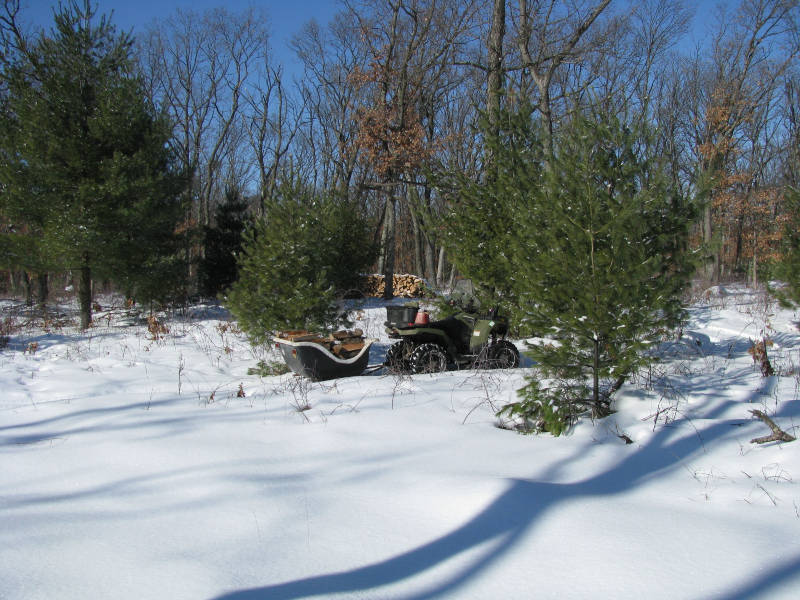
I Cut And I Cut Today And This Is All That's Left Of The Woods


- Quads, hailing from Grand Marsh Observatory atop Elk Castle Hill
Historic Bentley snowflake photos for sale in US
Ten of the pioneering photos of snowflake crystals US farmer Wilson A Bentley began taking more than a century ago are to be sold in New York.
Bentley (1865-1931) is credited with capturing the first images of single snowflakes on camera. He made thousands of the jewel-like prints, no two alike.
His photomicrography technique involved a microscope and a bellows camera.
He caught pneumonia in a blizzard and died just weeks after the publication of his book Snow Crystals.
The sale of his crystal images is a rare event, the Associated Press news agency reports.
Chicago art gallery owner Carl Hammer is selling them along with 16 of Bentley's winter scenes at an antiques show at New York's American Folk Art Museum.
"They're remarkably beautiful," said Mr Hammer.
"There are imperfections on the outer edges of the image itself and on the paper, but the images themselves are quite spectacular."
'Good for 100 years'
Snowflake expert Kenneth G Libbrecht said the photos did not meet modern standards because of the "crude equipment" Bentley used.
"But he did it so well that hardly anybody bothered to photograph snowflakes for almost 100 years," Mr Libbrecht added.
Bentley, who was known as The Snowflake Man, wrote in 1925: "Under the microscope, I found that snowflakes were miracles of beauty and it seemed a shame that this beauty should not be seen and appreciated by others.
"Every crystal was a masterpiece of design, and no one design was ever repeated. When a snowflake melted, that design was forever lost."
Mr Libbrecht said the method of singling out a crystal to photograph had not changed.
"You basically let the crystal fall on something, black or dark-coloured, and then you have to pick it up with a toothpick or brush and put it on a glass slide," he said.
source....
Bentley (1865-1931) is credited with capturing the first images of single snowflakes on camera. He made thousands of the jewel-like prints, no two alike.
His photomicrography technique involved a microscope and a bellows camera.
He caught pneumonia in a blizzard and died just weeks after the publication of his book Snow Crystals.
The sale of his crystal images is a rare event, the Associated Press news agency reports.
Chicago art gallery owner Carl Hammer is selling them along with 16 of Bentley's winter scenes at an antiques show at New York's American Folk Art Museum.
"They're remarkably beautiful," said Mr Hammer.
"There are imperfections on the outer edges of the image itself and on the paper, but the images themselves are quite spectacular."
'Good for 100 years'
Snowflake expert Kenneth G Libbrecht said the photos did not meet modern standards because of the "crude equipment" Bentley used.
"But he did it so well that hardly anybody bothered to photograph snowflakes for almost 100 years," Mr Libbrecht added.
Bentley, who was known as The Snowflake Man, wrote in 1925: "Under the microscope, I found that snowflakes were miracles of beauty and it seemed a shame that this beauty should not be seen and appreciated by others.
"Every crystal was a masterpiece of design, and no one design was ever repeated. When a snowflake melted, that design was forever lost."
Mr Libbrecht said the method of singling out a crystal to photograph had not changed.
"You basically let the crystal fall on something, black or dark-coloured, and then you have to pick it up with a toothpick or brush and put it on a glass slide," he said.
source....
Tuesday, February 2, 2010
The star Spica and the planet Saturn flank the Moon
The star Spica and the planet Saturn flank the Moon late tonight. They rise by around midnight and are in the southwest at first light tomorrow. Golden Saturn is to the upper left of the Moon, with blue-white Spica to the lower left.
- Quads, hailing from Grand Marsh Observatory atop Elk Castle Hill
- Quads, hailing from Grand Marsh Observatory atop Elk Castle Hill
Humans were once an endangered species
Scientists from the University of Utah in Salt Lake City in the U.S. have calculated that 1.2 million years ago, at a time when our ancestors were spreading through Africa, Europe and Asia, there were probably only around 18,500 individuals capable of breeding (and no more than 26,000). This made them an endangered species with a smaller population than today’s species such as gorillas (approximately 25,000 breeding individuals) and chimpanzees (an estimated 21,000). They remained an endangered species for around one million years.
Modern humans are known to have less genetic variation than other living primates, even though our current population is many orders of magnitude greater. Researchers studying specific genetic lineages have proposed a number of explanations for this, such as recent "bottlenecks", which are events in which a significant proportion of the population is killed or prevented from reproducing. One such event was the Toba super-volcano in Indonesia that erupted around 70,000 years ago, triggering a nuclear winter. Only an estimated 15,000 humans are thought to have survived. Another explanation is that the numbers of humans and our ancestors were chronically low throughout the last two million years, sometimes with only 10,000 breeding individuals surviving.
The new research is concerned with the entire genome rather than specific genetic lineages studied in the earlier research work. Using a new method of studying genetic markers of DNA in the genome has allowed geneticists to study the genetics not only modern humans, but also our early ancestors such as Homo erectus (thought the most likely to be our direct ancestors), H. ergaster and archaic H. sapiens. Remarkably, they found there was enough information in only two human DNA sequences to estimate the ancient population size.
Human geneticist Lynn B. Jorde and colleagues studied parts of the genome containing mobile elements called Alu sequences, which are sections of DNA around 300 base-pairs long that randomly insert themselves into the genome. This is a rare occurrence, but once inserted, they tend to stay in place over generations, and act as markers, rather like fossils, for ancient parts of the genome. On average, regions containing Alu insertions are older than other regions, and because they are old these regions have been shaped more by the forces that applied to ancient populations than to recent bottlenecks (such as Toba) and expansions.
The researchers studied mutations in the DNA near these Alu markers in two modern human genomes that have been completely sequenced. Older regions containing Alu sequences have more mutations because they have been in existence longer, and the researchers used the nucleotide diversity to estimate the age of the region of the genome. They then compared these regions with the overall diversity in the two genomes to estimate the differences in effective population size, and thus the genetic diversity between modern humans and our ancestors.
From these studies, they calculated there was more genetic diversity in our early ancestors than there is in modern humans. They also came to the conclusion that there had been a catastrophic event around one million years ago that was at least as devastating as the Toba volcanic eruption, and which had almost wiped out the species.
Jorde said that humans and our ancestors have gone through cycles of large population size and also periods when we were endangered.
source....
Modern humans are known to have less genetic variation than other living primates, even though our current population is many orders of magnitude greater. Researchers studying specific genetic lineages have proposed a number of explanations for this, such as recent "bottlenecks", which are events in which a significant proportion of the population is killed or prevented from reproducing. One such event was the Toba super-volcano in Indonesia that erupted around 70,000 years ago, triggering a nuclear winter. Only an estimated 15,000 humans are thought to have survived. Another explanation is that the numbers of humans and our ancestors were chronically low throughout the last two million years, sometimes with only 10,000 breeding individuals surviving.
The new research is concerned with the entire genome rather than specific genetic lineages studied in the earlier research work. Using a new method of studying genetic markers of DNA in the genome has allowed geneticists to study the genetics not only modern humans, but also our early ancestors such as Homo erectus (thought the most likely to be our direct ancestors), H. ergaster and archaic H. sapiens. Remarkably, they found there was enough information in only two human DNA sequences to estimate the ancient population size.
Human geneticist Lynn B. Jorde and colleagues studied parts of the genome containing mobile elements called Alu sequences, which are sections of DNA around 300 base-pairs long that randomly insert themselves into the genome. This is a rare occurrence, but once inserted, they tend to stay in place over generations, and act as markers, rather like fossils, for ancient parts of the genome. On average, regions containing Alu insertions are older than other regions, and because they are old these regions have been shaped more by the forces that applied to ancient populations than to recent bottlenecks (such as Toba) and expansions.
The researchers studied mutations in the DNA near these Alu markers in two modern human genomes that have been completely sequenced. Older regions containing Alu sequences have more mutations because they have been in existence longer, and the researchers used the nucleotide diversity to estimate the age of the region of the genome. They then compared these regions with the overall diversity in the two genomes to estimate the differences in effective population size, and thus the genetic diversity between modern humans and our ancestors.
From these studies, they calculated there was more genetic diversity in our early ancestors than there is in modern humans. They also came to the conclusion that there had been a catastrophic event around one million years ago that was at least as devastating as the Toba volcanic eruption, and which had almost wiped out the species.
Jorde said that humans and our ancestors have gone through cycles of large population size and also periods when we were endangered.
source....
Monday, February 1, 2010
I-95 billboard 'man and bear' prompt 911 calls


A local car dealer's unconventional billboard advertising is attracting more than passing attention from motorists.
A life-sized mannequin perched with a teddy bear atop the billboard near Interstate 95's northbound exit 26 is also prompting occasional calls to the emergency 911 number from travelers who fear the figures are about to topple off.
But dispatchers at State Police Troop G barracks tell concerned callers that the "man" isn't real -- and that he and his companion bear have been up there for a while.
A marketing device designed to increase customer traffic for BMW of Bridgeport's overnight test drive offer, the mannequin is dressed in pajamas. The man and bear were lifted to the top of the billboard about two months ago, said Tim Coughlin, the North Avenue dealership's general sales manager.
No one expected the mannequin idea -- which dealership officials brainstormed roughly three years ago -- to generate 911 calls, he said.
"For whatever reason, it's working because people are looking at it," Coughlin said with a chuckle. "It has become distinctive and sort of like a signature."
Before the teddy bear motif, another BMW of Bridgeport billboard featured a dummy with extra long legs hanging down over the sign to signify the dealership's growth, he said.
According to Troop G, there have been at least three calls since the current billboard went up, and they've mostly come after dark.
This isn't the first time BMW of Bridgeport has heard comments on its advertising.
Most of the feedback has been positive, Coughlin said, but there was the time that a man came to the dealership and waited 10 minutes to speak to a manager.
"He says, `I want to know, why do you have that mannequin with the long legs?' " Coughlin recalled. "He said, `I don't get it. I don't think it's funny and I'm offended by it.' "
Still, the dealership has found that putting dummies atop billboards is smart advertising.
The dealer hopes the teddy bear and pajamas promote the message, "We'll take care of you," Coughlin said. Under the program, the dealership allows prospective buyers to take home a new BMW and "let it sleep in your garage for the night" before committing to buying the vehicle.
"It's done very well for us ... We do a lot of overnight test drives because of it," he said, adding that such prolonged "test drives" often result in sales.
And while the man ensconced on the billboard has been seated securely from the start, the teddy bear has been in peril.
The giant stuffed toy even disappeared for a time -- whether he was taken or simply fell off the billboard, no one knew -- and never was found.
The dealership considered offering a reward, Coughlin joked, but in the end, "We just replaced him."
source....
Subscribe to:
Posts (Atom)